My focus is shifting toward entrepreneurship. I’m exploring how AI can understand and act in the physical world, starting with chemistry. My two bets are autonomous chemistry labs that turn model decisions into experiments, and simulation models that predict how chemical reactions unfold.
Building the last mile between AI and the physical world.
Chemistry is where I’m placing that bet: connecting what a model predicts with what happens in a real experiment. I’m pursuing two complementary routes toward that goal.
Act in the physical world
Autonomous chemistry labs
I want to build labs where AI can plan experiments, coordinate automated equipment, and learn from the results.
The Agentic Model would be the lab’s decision-making brain, turning scientific goals into experimental steps and adapting to observations. A catalysis foundation model would provide specialized knowledge for reasoning about catalysts and reaction conditions. Lab automation would connect those decisions to physical experiments.
Predict the physical world
Chemical reaction simulation
My second bet is a Simulation Model that models chemical reactions and aims to predict their behavior under real experimental conditions.
The goal is to explore how changes in catalysts and reaction conditions affect outcomes before running an experiment. Predictions would guide what to test in the lab, while experimental observations would help evaluate and improve the model.
Together, these routes aim to connect prediction, experimentation, and learning: use simulation to guide experiments, then use physical evidence to improve the next prediction.
Selected publications
Selected work on embodied reasoning, multimodal AI, trustworthy models, and human-aligned evaluation.
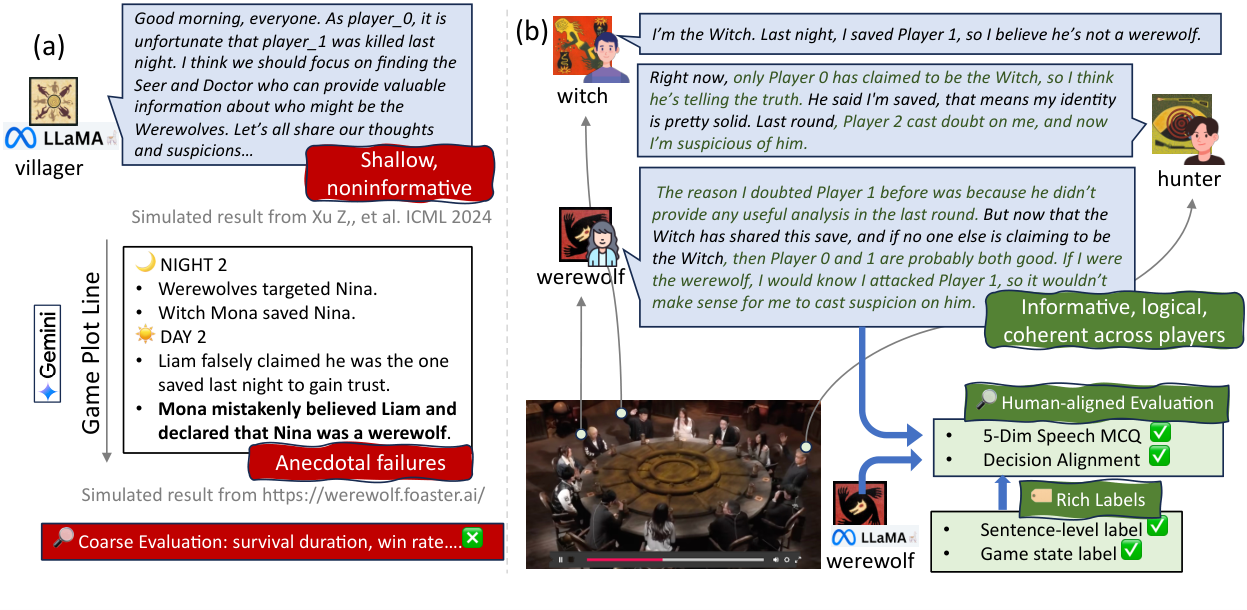
WereBench, a human-verified multimodal Werewolf dataset, and WereAlign, a strategy-alignment framework that scores LLMs against human play instead of survival time.
One paper was accepted by Nature Computational Science.
Admitted to MBZUAI, where I commenced my PhD studies in August 2025.
One paper was accepted by NAACL 2025.
One paper was accepted by Communications Chemistry.
First day as a visiting student at MBZUAI under the supervision of Prof. Xiuying Chen.
One paper was accepted by EMNLP 2024.
One paper was accepted by ECCV 2024.
Prof. Ling Chen accepted me as an undergraduate research assistant at the Australian Artificial Intelligence Institute (AAII).
I was selected as an international exchange student majoring in Software Engineering at UTS.
Background
Education
PhD student in NLP at MBZUAI, supported by the UAE Government Scholarship. Previously, Software Engineering at UTS with First Class Honours and the Dean’s List 2025 award.
Experience
Research experience at Alibaba, MBZUAI, UTS, and NTU, spanning multimodal AI, embodied agents, and trustworthy models.
Education and experience in detail
Education
2025.08 – 2029.05
PhD, Mohamed bin Zayed University of Artificial Intelligence
Expected · NLP Department · UAE Government Scholarship
2021.06 – 2025.05
B.E. (Honours), University of Technology Sydney
Software Engineering · First Class Honours · GPA 3.90/4.00 · Dean's List 2025 (Top 2%)
Experience
2026.03 – now
Alibaba Group
Algorithm Engineer (Research Intern) · Supervised by Xiang Wang
I’d love to hear from potential co-founders, researchers, and people working in chemistry labs who see opportunities for AI and automation. Tell me what you’re working on and where our interests might meet.
 PhD, Mohamed bin Zayed University of Artificial Intelligence
 B.E. (Honours), University of Technology Sydney
 Alibaba Group
 Nanyang Technological University